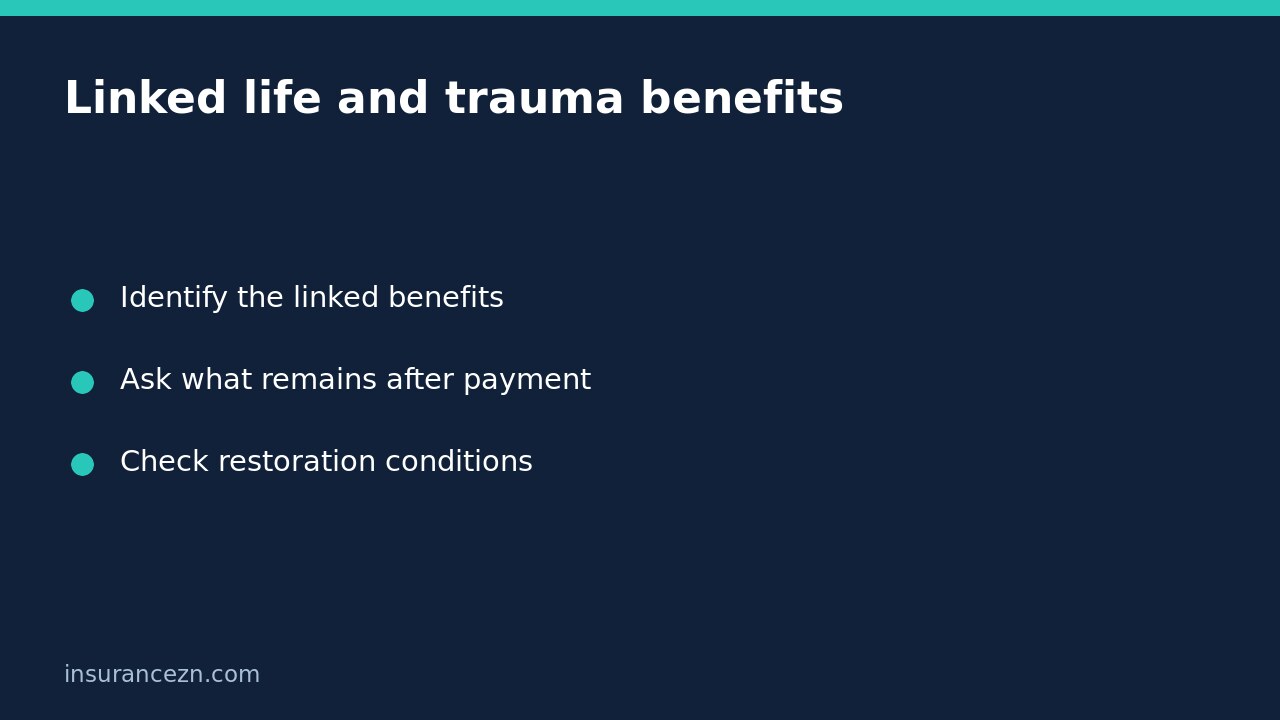

A policy schedule can list a death benefit and a trauma benefit on separate lines without promising two fully independent pools of money. If those benefits are linked, a trauma payment may reduce the life cover left for a later death claim. Adding the headline amounts can therefore produce a misleading picture of family protection.
The practical task is to map what remains after a payment, not to predict a claim outcome. This matters when comparing a linked package with standalone cover, reviewing a claim decision, or updating household records after an insurer pays a benefit.
Identify whether the benefits share a limit
Gather the policy schedule, PDS, supplementary documents and any personal terms. Look for wording such as linked, attached, accelerated, standalone or reduction of benefits. Insurers do not necessarily use identical labels, so the rule describing interaction matters more than a marketing name.
ASIC’s Moneysmart trauma insurance page explains that packaged trauma and life cover can result in life cover being reduced by a trauma claim payment. Its life cover page also warns that payments under other packaged benefits may reduce life cover. Neither statement establishes that your particular policy has that structure.
Ask the insurer to identify the clause governing your combination. If an adviser arranged several benefits, request a simple diagram identifying which limits interact. Separate policy numbers can help identify contracts, but do not use a numbering pattern as the sole proof that benefits are independent.
Make a before-and-after benefit map
Use a worksheet with a row for death cover, trauma cover and any other benefit mentioned in the relevant reduction clause. Include columns for the amount before a claim, the proposed payment, the reduction rule and the amount the insurer says remains afterward.
Use your actual schedule amounts only after confirming which are current. An old quotation, a previous annual statement and an insurer’s live portal can show different dates. Keep the document date beside each amount so an apparent discrepancy can be resolved.
A plain-language scenario is useful: If an eligible trauma claim is paid now and the insured person later dies, what death benefit would be available immediately after that trauma payment, assuming no other change? Ask for the answer in writing, with the relevant clause. This is a contract clarification, not an assertion that either claim will be accepted.
Do not invent a subtraction formula where the policy has offsets, partial benefits or other interactions. The benefit map should capture the actual rules rather than force them into a simple calculation.
Keep eligibility and benefit interaction separate
A reduction clause answers what happens after a covered payment. It does not establish that a diagnosis, illness or event satisfies the trauma definition. Moneysmart notes that covered conditions and medical definitions differ among insurers and directs readers to the PDS.
That means two questions must remain separate: does the event meet the policy definition, and what does an accepted payment do to other cover? A larger advertised trauma amount does not resolve either question by itself.
For the broader distinction between the products, see our comparison of trauma cover and life insurance. For your own claim, use the insurer’s claims team and policy wording. This article does not provide medical diagnosis or treatment advice.
Investigate any restoration or buy-back wording carefully
If your documents mention restoring a death benefit, ask what action is required and when. Do not assume that a reduced amount automatically returns, or that an optional restoration feature was selected just because it appears somewhere in the PDS.
Useful questions include whether the feature applies to your cover, whether a waiting period applies, whether there is an application or election deadline, what amount can return, and what exclusions or premium changes affect the restored benefit. These are questions to investigate, not features promised across all policies.
Ask the insurer to distinguish cover available immediately after the trauma payment from cover that might become available later. A future possibility should not be entered in today’s household records as if it were already active. Save the insurer’s confirmation and any forms required to exercise an option.
Review the purpose of the remaining death cover
The money used after a trauma payment and the money needed following a later death may serve different purposes. A household might use an accepted trauma benefit for living expenses or debt, while expecting death cover to help dependants with future bills. Do not count the same expected money twice in a family plan.
A useful review starts with a list of obligations rather than a target insurance amount: housing, debts, ongoing household costs and people who rely on income. Then record available resources separately, including resources that may have changed after illness or time away from work.
This exercise identifies questions for a licensed financial adviser; it does not tell you whether to buy more cover. New or increased cover may involve assessment and terms different from existing insurance. Do not cancel a current policy because a new quote looks simpler on paper.
Update records after an actual payment
When a trauma claim has been paid, ask for an updated schedule or written confirmation of remaining benefits, the effective date and any ongoing premiums. Keep the claims payment letter with that confirmation. A bank deposit proves that money arrived, not the exact future death benefit.
Check whether your own household spreadsheet and any adviser-held summary still show the pre-claim amount. Correct those records using the insurer’s confirmation, not a remembered telephone conversation. If a restoration deadline applies, record it with the required action and keep evidence when the action is completed.
If different documents disagree, ask the insurer to reconcile them before relying on the higher figure. A concise request might say: Please confirm the death and trauma benefits now in force after this payment, any reductions applied and any available restoration steps under my specific contract.
Questions to take to the insurer
- Are the trauma and death benefits linked under this policy?
- Which payments reduce which other benefits?
- What amount remains immediately after the payment?
- Does any restoration option actually apply, and what must I do?
- Can you provide an updated written schedule and explain the ongoing premiums?
These questions turn a package of headline numbers into a clearer account of what the contract provides at different stages.
Sources and advice boundary
Primary sources: ASIC Moneysmart: Trauma insurance and ASIC Moneysmart: Life insurance cover. The discussion of a benefit map is an educational method for asking contract-specific questions.
This is general information for Australian readers, not personal financial advice. Check the current PDS, policy schedule and supplementary terms, and contact your insurer for individual cover. Seek licensed personal advice before making changes based on your circumstances.