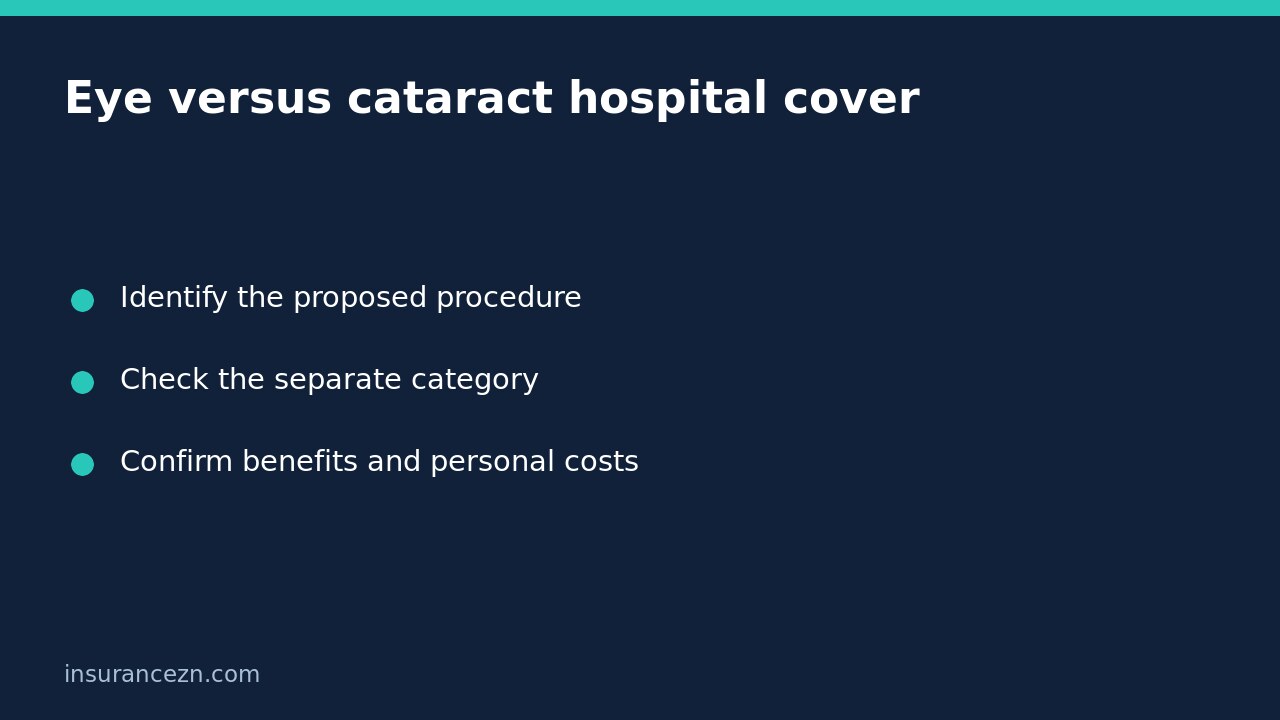

A hospital insurance policy that includes the clinical category Eye does not automatically include Cataracts. Although both concern the same part of the body, Australia’s standard hospital categories list cataract procedures separately. Check the category for the proposed treatment, not just the everyday name of the condition.
This distinction matters when reading a policy summary before a planned admission. A broad-sounding heading is not permission to assume that every operation on that body part attracts benefits. Your next step is to match the specialist’s proposed procedure to the insurer’s written cover explanation.
What the official category descriptions actually separate
The government’s clinical categories guide describes Eye as hospital treatment for investigation and treatment of the eye and the contents of the eye socket. It gives examples including retinal detachment, tear duct conditions and eye infections. It then explicitly places cataract procedures in the separate Cataracts category.
The Cataracts description covers hospital surgery to remove a cataract and replace it with an artificial lens. The Eye description also places eyelid procedures separately under Plastic and reconstructive surgery. These boundaries show why neither the body part nor the specialist’s occupation is a reliable substitute for checking the actual treatment.
Do not diagnose your own category from symptoms. A person reporting blurred vision could be discussing different investigations or treatments with their clinician. Insurance administration should follow the proposed clinical plan, not determine it.
Collect a procedure description before asking about benefits
Ask the treating practice for the proposed procedure name, available Medicare Benefits Schedule item numbers, intended admission date and exact hospital or day facility. Request a written fee estimate and ask whether other practitioners will bill separately. If the plan is still provisional, label it provisional when contacting the fund.
Send the insurer those details and identify your exact hospital product. A useful question is: ‘For this procedure and these proposed items, which clinical category applies, and is it included, restricted or excluded on my current policy? Please confirm any waiting periods and the hospital benefit arrangements for the named facility.’
Where the practice has not supplied an item number, ask what information the insurer needs to assess the proposed treatment. Do not invent a number from an internet example or treat an incomplete enquiry as a confirmed benefit estimate.
A worked reading example without assuming payment
Imagine a member whose summary lists Eye as included but shows Cataracts as excluded. The specialist proposes cataract removal with an artificial lens. The member should not rely on the Eye entry simply because the procedure is eye surgery. They should ask the insurer to assess the proposed procedure against the separate Cataracts entry and explain the implications in writing.
Now imagine the summary includes Cataracts. That resolves a category question, not every cost or eligibility question. Waiting periods, membership status, hospital arrangements and the particular treatment still need checking. A category inclusion is not a promise that the entire admission will be free.
Keep hospital, medical and device estimates separate
The government’s out-of-pocket costs guidance distinguishes hospital fees, treating providers’ medical fees and possible prosthesis costs. Obtain the relevant estimates rather than treating one hospital quotation as the complete bill.
Ask the surgeon about their own fees and any other clinicians involved. Ask the hospital about admission charges and the insurer about benefits for the named facility. Where an implanted lens is proposed, request a specific explanation of its benefit and any personal cost; do not assume every lens option has identical funding.
For a separate check on facility arrangements, see why an agreement hospital does not mean every bill has no gap. An agreement does not erase all medical charges or policy excesses.
Questions to settle before relying on the answer
- Does the confirmation identify the actual procedure, policy and admission date?
- Does it distinguish the Eye and Cataracts entries rather than just saying ‘eye surgery’?
- Are unresolved waiting periods, restrictions or missing information clearly stated?
- Do the provider estimates and fund explanation describe the same treatment?
What if the planned operation changes? Ask for an updated treatment description and revised insurer confirmation. An answer about an earlier plan should not silently carry over to a different procedure.
Should an urgent eye problem wait for an insurance enquiry? No. Seek appropriate medical care promptly; administrative checks must not delay urgent assessment.
This is general information for Australian readers, not personal financial advice. Benefits depend on the applicable policy wording, fund rules, PDS where provided, waiting periods and individual circumstances. Obtain treatment-specific confirmation from your insurer.