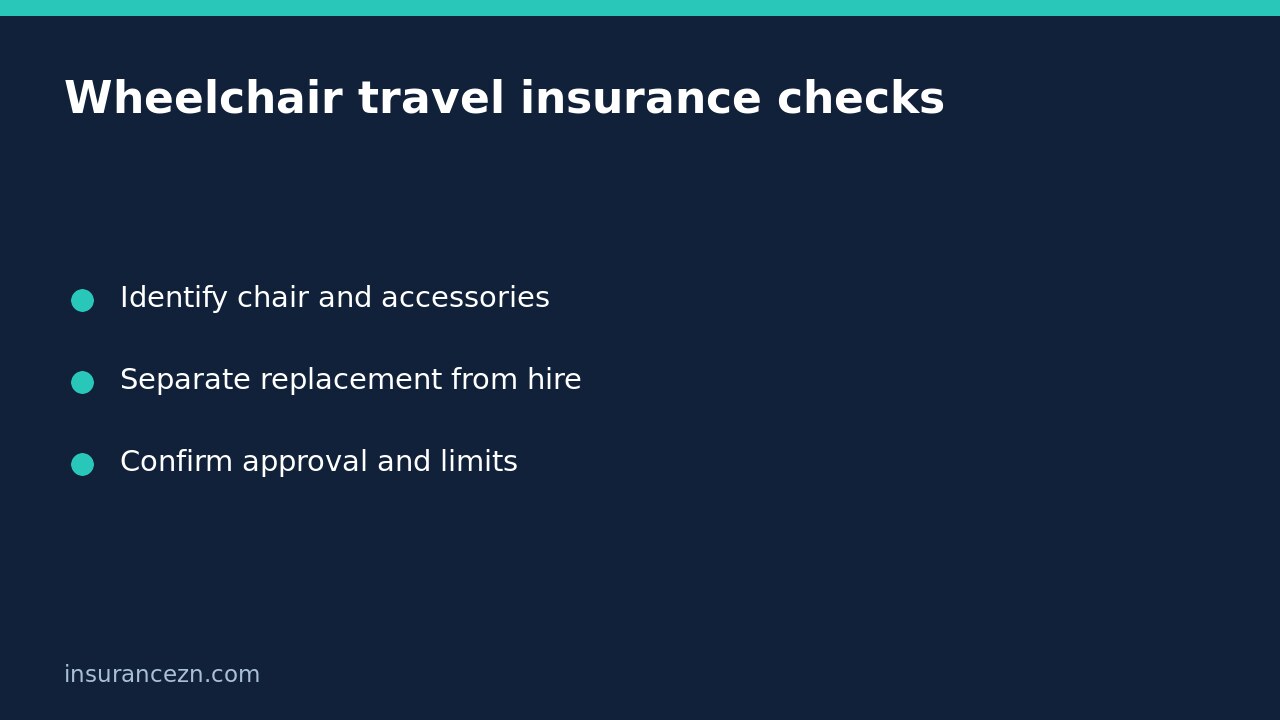

If you rely on a wheelchair overseas, compare more than the policy’s headline baggage limit. Ask separately about the insured chair, temporary equipment while it is unavailable, and practical assistance arranging a suitable replacement. Cover for one cost does not establish cover for the others.
This is general information for Australian readers, not personal financial advice. Benefits depend on the applicable Product Disclosure Statement (PDS), policy wording, certificate, exclusions and any accepted amendments. The questions below do not imply that every travel insurer offers wheelchair replacement or hire benefits.
Start with the equipment you actually use
Smartraveller’s disability travel guidance recommends checking whether a policy covers replacing medical devices, aids or equipment that are lost, damaged or stolen. It also advises declaring your disability and checking airline equipment requirements. Those are separate tasks: airline permission to carry a chair is not insurance acceptance.
Prepare a short equipment description before requesting quotes. Include whether the chair is manual or powered, ownership or rental status, make and model, approximate replacement cost, and essential accessories. Identify cushions, chargers, batteries and controls rather than assuming they are all treated as one insured item. Share medical information through the insurer’s appropriate secure process, not in a public enquiry.
Compare permanent loss and temporary unavailability
Ask each shortlisted insurer which section would assess an accidental-damage, theft or loss claim for this particular chair. Request the relevant clause and any equipment-specific exclusion, item limit, excess or valuation rule. A large total luggage allowance does not answer whether the chair is eligible or how its value would be assessed.
Then ask a different question: if the chair is delayed, being repaired or awaiting assessment, is suitable temporary hire an eligible expense? Find out what event must occur, whether prior approval is required, and what duration or monetary limit applies. Do not assume a replacement benefit also pays hire charges, delivery, fitting or accessible transport to collect equipment.
For example, imagine a traveller whose powered chair is damaged during a journey. Purchasing another chair is one potential expense; hiring an interim chair is another. A policy response about the purchase cost leaves the interim arrangement unresolved. Ask for answers to both scenarios rather than interpreting a general assurance as approval of the whole plan.
Check whether the proposed assistance is usable
A theoretically available replacement may not meet your needs. Record the essential functions and ask your treating professional or equipment supplier what information a temporary supplier would need. Discuss local availability before departure where possible. An insurer’s assistance service is not necessarily an equipment supplier, and a contact referral is not a promise to fund the service.
- Who helps identify an appropriate supplier, and when is that service reachable?
- Must the insurer approve the supplier, hire period or repair estimate first?
- Would you need to pay upfront, and what evidence would a reimbursement assessment require?
- If no suitable equipment is available, which other policy provisions, if any, could be considered?
Keep airline handling arrangements separate. Smartraveller notes that airlines may restrict battery-powered wheelchairs and recommends checking the airline’s policy. Insurance does not replace transport safety requirements or guarantee carriage.
Turn quote answers into a comparison record
Use one row per insurer with columns for the exact equipment accepted, permanent replacement terms, temporary hire terms, excess, exclusions and assistance process. Record unanswered questions explicitly. Do not mark a policy as covering hire simply because its representative has forwarded your question for review.
Before relying on an answer, reconcile it with the actual policy documents and obtain written confirmation of any accepted variation and its effective date. Save the applicable PDS and certificate offline. For broader item-limit context, see our guide to comparing baggage limits for one expensive item; medical-equipment eligibility still needs its own check.
Quick questions before departure
Does medical cover automatically insure my chair? Do not assume so. Ask about the device under the applicable equipment or property provisions as well as your separate medical needs.
Does an approved replacement claim mean hire is approved? Not necessarily. Request a separate decision on the hire expense, supplier and period before committing to costs where practicable.
What documents should I keep? Retain equipment identification, ownership or rental evidence, condition photographs, transport reports, receipts and the insurer’s instructions. Evidence supports assessment; it does not guarantee acceptance or payment.
Smartraveller’s travel insurance overview explains why inclusions, exclusions and definitions must be checked in the PDS. Arrange an accessible contingency plan as well as insurance, and never delay urgent medical care while checking administration.