
If an Australian health fund says your prepaid cover now ends earlier than expected, ask it to reconcile the original payment arrangement with the current membership ledger. Do not assume either that every advance payment guarantees a fixed end date or that a new balance proves you owe more. The key question is whether rate protection applied to your exact membership and prepaid period.
This is general information for Australian readers, not personal financial advice. Your policy documents, fund rules, Private Health Information Statement and any applicable PDS govern the arrangement. Payment allocation and rate protection do not establish eligibility for a particular treatment or guarantee a claim benefit.
Establish what the original payment bought
The government website PrivateHealth.gov.au explains rate protection and advance contributions. Some insurers offer rate protection for premiums paid twelve months ahead. Without that protection, a premium increase can mean paying a difference or having the advance payment cover a shorter period. That overview explains the possible mechanisms; it does not prove which one your fund applied.
Retrieve the dated quote, payment instructions, protection conditions, bank receipt and first statement issued after the payment. Identify the membership number, covered people, hospital and extras products, amount received and originally recorded paid-to date. A bank transfer proves money left an account, not that the fund allocated it correctly or accepted a particular protection arrangement.
Build a before-and-after membership timeline
Make a simple record with four columns: date, document, what changed and what remains unexplained. Start with the accepted prepayment, then add any premium notice, product amendment, membership change and revised statement. Keep original documents rather than overwriting them with corrected copies.
- Was a later premium rate applied during a period described as protected?
- Did someone join or leave the membership after the payment?
- Did hospital or extras cover change, with a different price or protection condition?
- Was part of the money allocated to an older balance or another membership?
- Was a discount removed, or was a receipt reversed or refunded?
These are questions to investigate, not conclusions about what the fund is entitled to do. Ask which exact transaction and contractual condition explain the revised date. If hospital and extras have separate adjustments, request separate entries rather than an unexplained combined balance.
Request the calculation, not just a balance
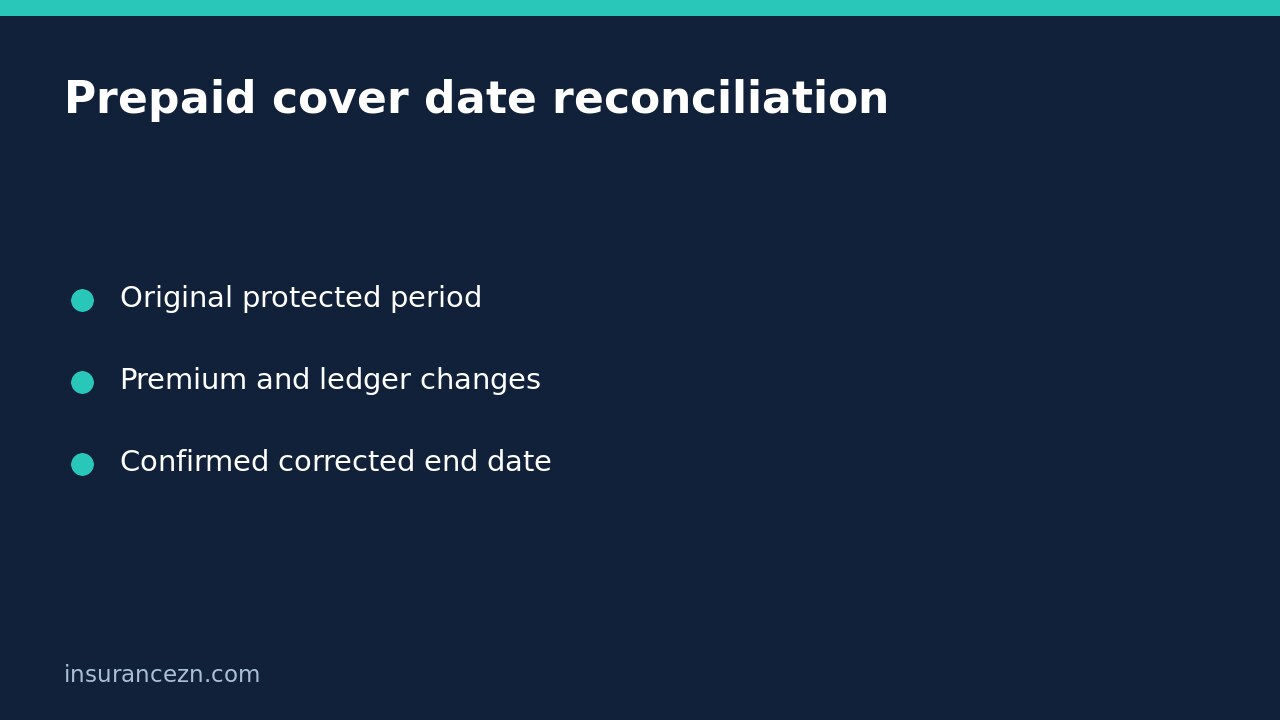
Ask for an itemised reconciliation showing the opening credit, payment received, applicable premium rates and dates, each adjustment and resulting paid-to date. Request the actual protection rule the fund says applied, including any condition affected by a membership amendment.
For example, imagine a member’s original statement says paid through 30 September, while a later statement says 31 August. This hypothetical discrepancy does not establish an error or a one-month debt. The fund needs to show whether the difference arose from a permitted price adjustment, a change in cover or an allocation mistake. Do not calculate the missing period using today’s daily rate if a different rate applied earlier.
A useful written request is: “Please reconcile my original prepaid end date with the revised date, identify the protection terms applied, and provide the transaction-level calculation. Please confirm my currently recorded paid-to date, any outstanding amount and what action is required while you investigate.”
Separate an investigation from a processed correction
An acknowledgement, case number or promise to refer the matter to billing is not a corrected membership record. If the fund agrees to amend the ledger, obtain a revised statement showing the processed credit, balance and paid-to date. Check the next payment instruction too, so a planned debit does not silently conflict with the resolution.
Do not simply stop an existing payment arrangement or pay a disputed amount twice without asking how cover will be maintained and any money allocated. If treatment is approaching, separately confirm membership status and obtain a treatment-specific benefit estimate. A billing correction does not remove waiting periods, exclusions, excesses or medical gaps. Never delay urgent care for this administrative check.
Questions before closing the enquiry
Does advance payment itself prove rate protection? No. The accepted conditions and the fund’s processed record need to establish that arrangement.
Is a corrected date enough? Also check the revised balance, next collection and written explanation, and preserve the old and new records.
What if I am still comparing payment arrangements? Our guide to checking rate protection before paying ahead addresses the buying decision. This reconciliation is for an existing payment whose recorded coverage period has changed.